



, 73°
Wind: mph,
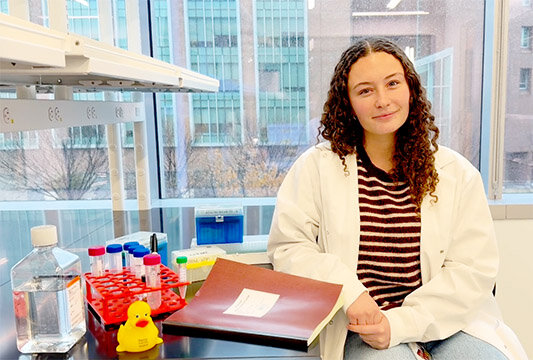
It’s not a surprise that Arnold resident Cameron White has loved science for as long as she can remember. It was her mother – longtime middle school science teacher, now vice principal at St. John the Evangelist School, Cindi White - who sparked her daughter’s interest in performing experiments and doing research even before Cameron started elementary school.
This May, the younger White will graduate from the University of Maryland’s Gemstone Honors program with a Bachelor of Science degree in bioengineering before starting the bioengineering Ph.D. program at the University of Pennsylvania School of Engineering and Applied Science in Philadelphia in the fall.
She will enter graduate school as just one of 2,500 National Science Foundation (NSF) Graduate Research Fellowship Program recipients. Nearly 14,000 applications were received. The fellowship includes full tuition and a three-year annual stipend of $37,000 to help fund her research project.
After graduating from Archbishop Spalding High School, White received the Banneker/Key Scholarship, the University of Maryland’s most prestigious award, which included full tuition, room, board and a book allowance.
“I was honored that University of Maryland recognized the potential in me as a researcher and provided me with the resources needed to achieve my goals,” White said. “I really liked the bioengineering program at Maryland and appreciated being closer to my home support system.”
During her freshman year in College Park, White was tasked with proposing a four-year research project. She chose to study HIV medication side effects. She had previously worked with HIV patients through research projects with the University of Maryland in Baltimore.
“In addition to improving my science skills and research abilities, being tasked with managing a four-year research project taught me to be a leader,” White said. “I learned that science doesn’t always work the way you thought it might, to pivot if you don’t get the results you expected or wanted, and to be resilient and confident in yourself.”
To be considered for the National Science Foundation’s Graduate Research Fellowship, White’s accepted proposal will consist of working with two University of Pennsylvania professors to determine if their individual research can be integrated.
Terence Peter Gade, a Matthew J. Wilson professor of research radiology II at the Perelman School of Medicine, has developed a promising liver cancer therapy in rats. The model is similar to what researchers might expect in human liver cancer.
Adam Stevens, assistant professor of cancer biology at the Perelman School of Medicine, has developed encouraging findings in engineered synthetic adhesion molecules. These molecules allow for cancer therapy to better adhere to solid mass tumors.
White will attempt to establish a good translational model for liver cancer, meaning, can the adhesion molecules be used in the rat therapy to make it even more effective? Her long-term goal is to apply synthetic adhesion molecules to other cancer therapies and study their effectiveness.
“The fellowship allows me to support two professors that I had already planned on working with,” White added. “It also gives me a lot of flexibility on how I want to pursue my work in the next five years.”
Though she isn’t sure where her research will take her after graduating with her Ph.D., White knows that cancer research will always be her focus. Her father, Craig, a former teacher at Old Mill High School, died of an aggressive melanoma when she was in middle school.
“The University of Pennsylvania is very supportive of both clinical cancer research and entrepreneurship,” White explained. “Maybe I’ll work in a lab to continue research. Maybe I’ll work to take clinical research to trial or to the marketplace.”
According to the NSF website, since 1952, the organization has funded more than 70,000 Graduate Research Fellowships out of more than 500,000 applicants. More than 40 fellows have gone on to become Nobel laureates, and more than 450 have become members of the National Academy of Sciences.
However her career plays out, White is excited for the opportunity to add her name to the list of renowned researchers working hard every day to drive cancer therapy innovation and better outcomes for cancer patients.


Comments
No comments on this item Please log in to comment by clicking here