



Clear, 73°
Wind: mph,
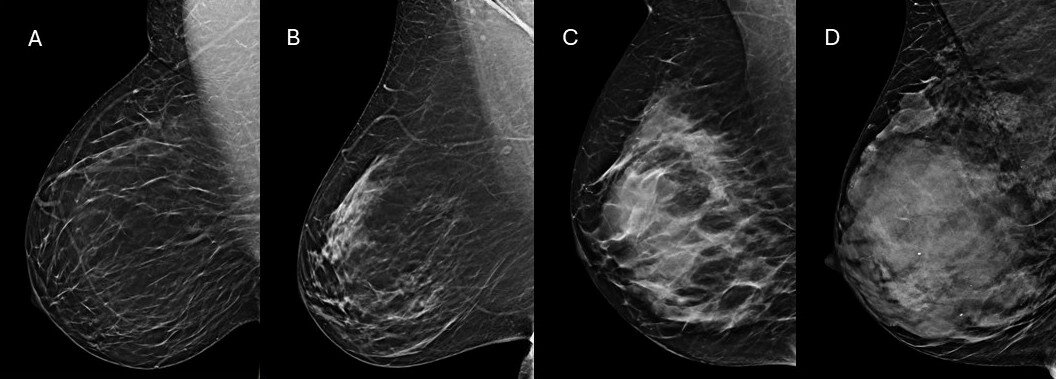
There is a lot of confusion about what dense breasts are and why they matter so much. When a primary care doctor does a physical exam and tells a patient that her breasts are dense, they mean that they feel dense. But on a mammogram, we’re not asking if the breasts feel dense; we’re asking if they look dense, which has nothing at all to do with how firm the breasts feel.
Instead, we are assessing how much of the breast is made of fat (transparent on the mammogram) versus gland (white clouds on the mammogram). Breasts come on a spectrum, from completely clear to completely cloudy, that we divide into four categories (A-D).
Dense breasts are important for two reasons. First, that density can hide things. It’s harder to see a mass in dense tissue. That part is more intuitive. But what’s also true is that dense breasts grow breast cancers more often. A woman who has extremely dense breasts (category D) has four to five times the risk of breast cancer than a woman who has fatty breasts (category A), just because her breasts are dense.
Having dense breasts is normal and common. Around 40% of women over 40 have heterogeneously dense breasts (category C, partly to mostly cloudy) and around 10% have extremely dense breasts (category D, completely cloudy).
There are several factors that contribute. Dense breasts are hereditary – a woman is more likely to have dense breasts if her mother or sisters have them. Body weight is also a factor. If a woman is very thin, she doesn’t have much fat, so her breasts tend to be dense. And if a woman loses weight and her breast size decreases, her breasts usually become more dense. Some drugs (for example, tamoxifen) decrease breast density and others (hormone replacement therapy) can increase breast density.
Tomosynthesis (a 3D mammogram) helps to look through dense tissue slice by slice; it’s an improvement but can still miss things, especially in denser breasts. Adding whole breast ultrasound increases our detection by around 30% but there can be a lot of false alarms.
Vascular-based supplemental screening with contrast-enhanced mammography (CEM) or breast MRI has been shown to be much more sensitive. A recent study by Dr. Fiona Gilbert in The Lancet in May 2025 showed that CEM and MRI found three times as many cancers as whole breast ultrasound and that the cancers were half the size (they were detected earlier, resulting in less treatment and better survival).
Read your report: Breast density is now required to be included in every mammogram report and patient letter, and many will include specific recommendations for additional screening. You can also ask your radiologist or primary care provider.
Bay Radiology is located at 277 Peninsula Farm Road, Suite A, in Arnold. Learn more at www.bay-radiology.com.
This branded content is brought to you by an expert in his or her respective field.



Comments
No comments on this item Please log in to comment by clicking here