


Clear, 54°
Wind: mph,
A couple living in Severna Park — we’ll call them Jack and Jill Homeowner — wake early one weekend morning to the sound of a chainsaw buzzing. Mr. Homeowner looks out the window to see their next-door neighbor taking down a tree. The project continues throughout the morning as Mr. Next-Door hacks up three or four trees from his waterfront property.
“Those are perfectly healthy trees,” Mr. Homeowner comments to Mrs. “Why is he cutting them down?”
“Maybe he wants a better view of the water,” Mrs. Homeowner guesses.
“That can’t be legal,” Mr. Homeowner ponders aloud.
It’s a hypothetical situation, but it’s one that’s common among neighbors anytime, anywhere, and particularly in Anne Arundel County — where the health of the watershed has become an intensely discussed political and social issue — it’s a situation in which any citizen should know what (and what not) to do.
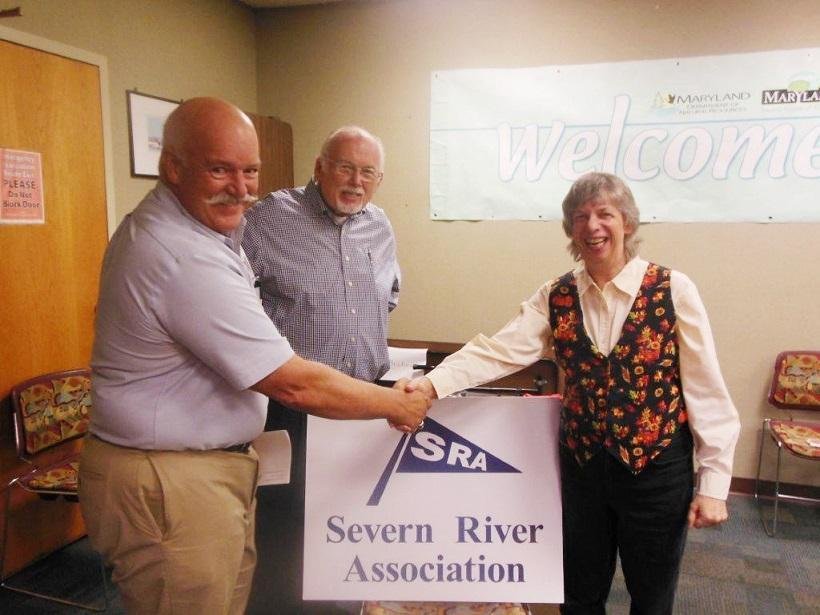
“If it looks wrong to you, it most probably is wrong,” John Peacock, head of Anne Arundel County's enforcement team at the Department of Inspections and Permits, told attendees at a recent educational presentation hosted by the Severn River Association. “Let us know.”
Peacock’s speech, titled “A Primer on Anne Arundel Environmental Code 101,” explained the county's basic building, zoning and environmental regulations; how Inspections and Permits enforces its regulations; and what citizens can do to help report suspected activities in their communities.
According to Peacock, the Maryland Critical Area Code was enacted by the Maryland legislature in the 1980s to help protect the Chesapeake Bay. All Maryland jurisdictions within the critical area must have local codes vetted by the critical area commission for the Chesapeake and Atlantic Coastal Bays. Although local codes vary somewhat from jurisdiction to jurisdiction, Anne Arundel County — with its 535 miles of shoreline — is considered one of the most stringent.
Peacock’s discussion touched on what commercial developers, independent contractors and even regular homeowners must consider before making a change to their property. A full breakdown of the code can be found at www.aacounty.org/planzone/development/criticalareas.cfm.
Such as in the hypothetical case of Mr. Next-Door, any trees that are cut down would need to be replaced by new trees, particularly on property within 100 feet of water, where the flora serves to filter stormwater. Peacock noted that this is the most common nonpermit critical area violation, as Mr. Next-Door is clearing flora within the critical area buffer without an approved vegetation management plan or grading permit. In other situations, developers get a permit to work on critical area properties but fail to comply with the approved plans. This is another common violation.
“Typical violations tend to be small in size because any clearing or earth disturbances of more than 5,000 square feet requires a grading permit, and grading-permitted properties are typically inspected on a biweekly basis,” explained Tracie Reynolds, public information officer for Anne Arundel County. “Nonpermit homeowner violations are typically the result of citizen complaints filed with the department. The priority is always to implement the code-required mitigation of the damage ASAP so the impact to the environment is minimized.”
But most homeowners are not trying to break the law on purpose, which is why Peacock and his team try to assist citizens through the process. Anyone planning to begin a project should contact the Office of Inspections and Permits (www.aacounty.org/ip).
The inspectors will then monitor operations that have permits to ensure that rules are followed. These projects include housing developments, clearing and grading properties, increased impervious pavement, tree removal, and clearing vegetation down to the waterline. If a permitted project violates its terms, Inspections and Permits will stop the project and remediate the problems. Continual violations result in fines and court orders.
Citizens are encouraged to be vigilant and report any suspicious development activity by calling 410-222-7777. Calls can be made anonymously, and the inspectors would rather receive a false alarm than risk missing illegal activity.
“We can't be everywhere all the time,” Peacock said. “So we need your help to let us know about suspected violations.”


Comments
No comments on this item Please log in to comment by clicking here